
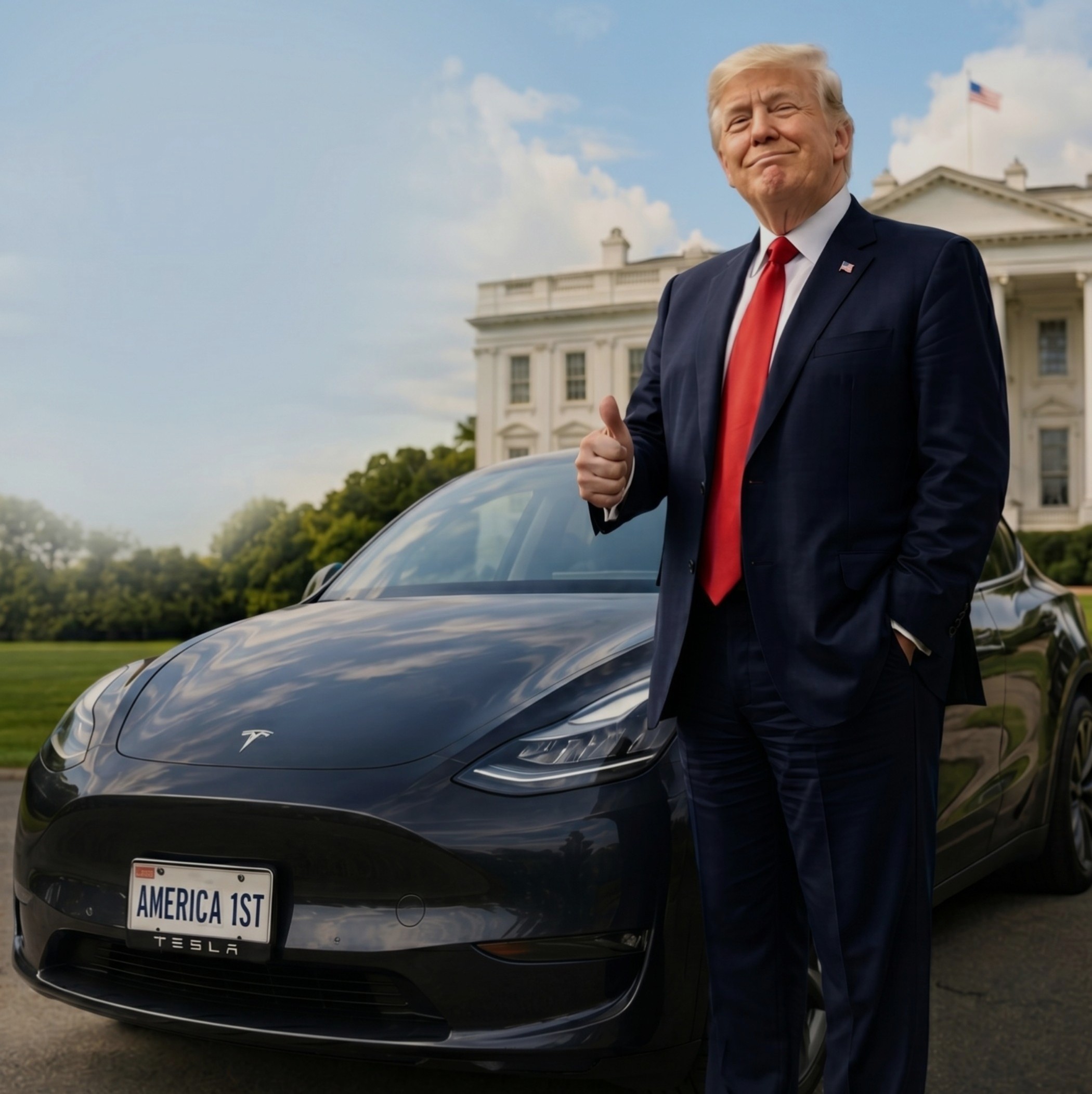
One of the biggest shifts in AI-powered creative work is the distance between a random idea and a finished campaign is now incredibly small.
Had a ridiculous idea in the shower last night.
“What if Trump tried to take credit for growing EV sales?”
10 minutes later, the campaign existed.
Headline.
Logo.
Body copy.
Fake political movement.
Full print ad.
That’s the bit people still underestimate about AI-powered creative.
It’s not just speed.
It’s the ability to chase strange little ideas before your rational brain kills them off.
Most creative concepts used to die somewhere between:
“Someone should do that…”
and
“Yeah but we don’t have the time/budget/designer/copywriter/photoshoot.”
Now you can prototype satire, campaigns, visuals, brand worlds, pitch ideas, ad concepts, and stupidly entertaining creative experiments almost instantly.
Some of them will be terrible.
Some will accidentally be brilliant.
But the gap between idea and execution has basically collapsed.
That changes creative work more than most people realise.
What AI actually changes in creative development
A lot of the conversation around AI focuses on efficiency.
Faster design.
Faster copywriting.
Faster production.
But the bigger shift is creative momentum.
AI removes the friction that used to stop ideas from being explored in the first place.
You no longer need to justify three days of design time just to see whether a concept might work.
You can test the idea immediately.
That means more experimentation. More weirdness. More satire. More risky creative thinking. More “what if?” moments that actually get built instead of abandoned.
Why this matters for marketing and advertising
The agencies and brands that benefit most from AI probably won’t be the ones trying to replace creativity.
They’ll be the ones using AI to explore more creative territory, faster.
Because the real advantage isn’t just content production.
It’s concept exploration.
The ability to rapidly prototype ideas, visual styles, campaign directions, ad concepts, social content, and brand worlds before committing major time or budget.
Which is both exciting… and mildly dangerous for the internet.