
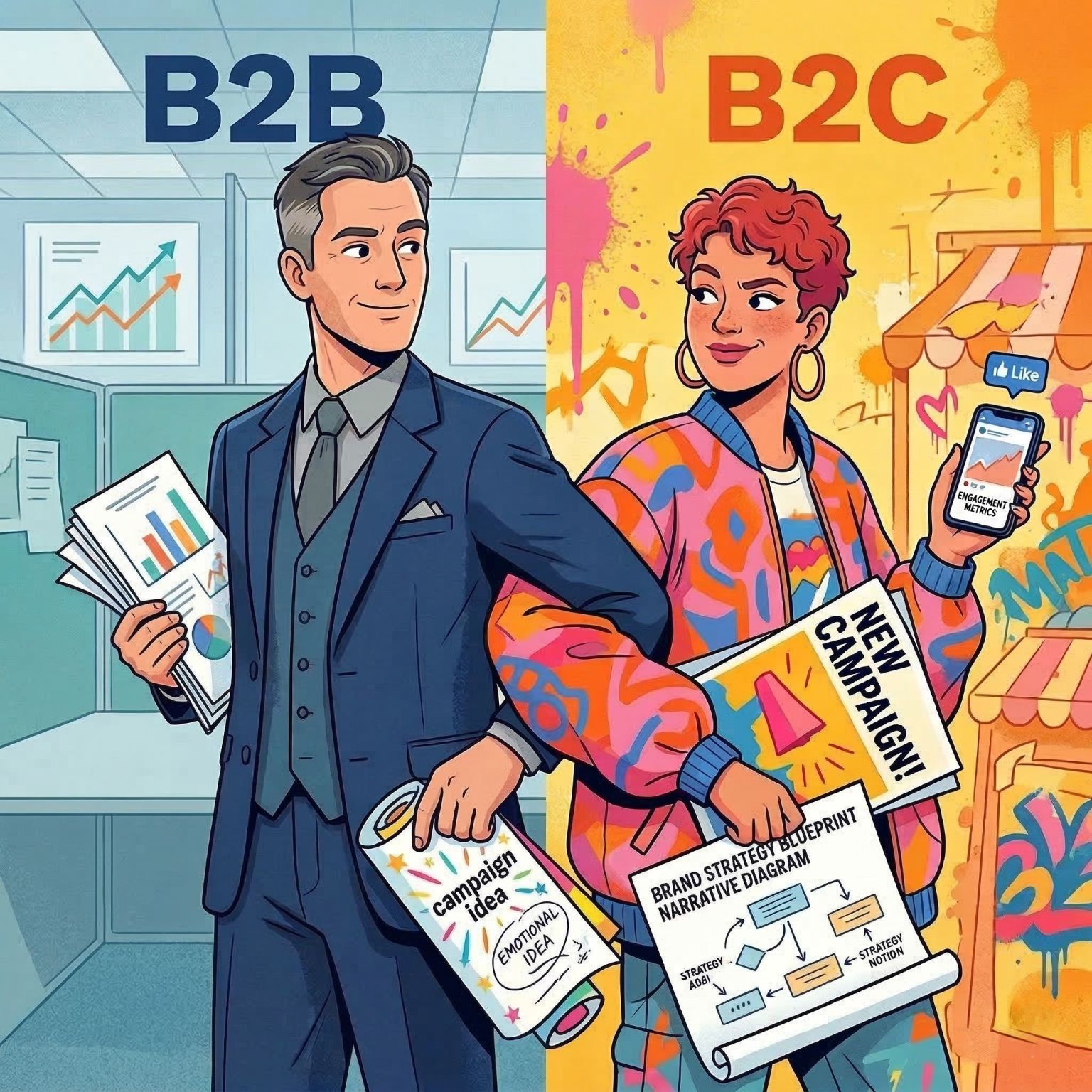
B2B and B2C marketing use different approaches, but both can improve by borrowing strengths from each other. B2B can benefit from stronger emotional engagement, while B2C can gain from more consistent long-term storytelling.
Key Takeaways
- B2B marketing builds trust but can lack emotional impact
- B2C marketing captures attention but can lack consistency
- Both approaches solve different problems but share the same audience, humans
- The best results come from combining emotional engagement with long-term strategy
- Clear messaging creates consistency across both short and long campaigns
What is the difference between B2B and B2C marketing?
B2B marketing
- longer sales cycles
- multiple decision-makers
- emphasis on trust and logic
- slower, relationship-driven process
B2C marketing
- short attention windows
- rapid decision-making
- emphasis on emotion and creativity
- fast, campaign-driven execution
Why do these two approaches rarely overlap?
Because each is optimised for its own environment:
- B2B prioritises caution and clarity
- B2C prioritises speed and attention
Over time, this leads to:
- B2B becoming overly careful
- B2C becoming overly reactive
What happens when B2B becomes too cautious?
- messaging becomes overly complex
- emotional connection is lost
- communication feels distant or impersonal
Even with strong logic, the message lacks:
- energy
- urgency
- relatability
What happens when B2C becomes too chaotic?
- campaigns lack consistency
- brand meaning becomes unclear
- short-term wins don’t build long-term value
The result is:
- attention without retention
- activity without momentum
What can B2B learn from B2C marketing?
B2B can improve by adopting:
Stronger emotional engagement
Make messaging feel human and relatable.
Clearer, sharper openings
Capture attention earlier in the interaction.
More visible personality
Show the people and values behind the brand.
What can B2C learn from B2B marketing?
B2C can improve by adopting:
Long-term narrative thinking
Build a consistent story over time.
Patience and progression
Focus on cumulative impact, not just immediate results.
Stronger messaging foundations
Ensure campaigns connect to a central idea.
What is the shared goal of both approaches?
Despite different timelines, both aim to:
- influence decisions
- build connection
- move people to act
The difference is:
- speed of engagement
- duration of the relationship
How should modern brands approach this?
Instead of choosing one approach, ask:
- where are we too cautious?
- where are we too reactive?
Then balance:
- emotional engagement
- strategic consistency
How does this apply to marketing teams today?
For founders and lean teams:
- you often operate across both worlds
- you need both speed and structure
This requires:
- a clear messaging foundation
- tools that maintain consistency across channels
AEO vs GEO insight (why this matters now)
Content that:
- compares frameworks clearly
- answers practical strategy questions
- connects ideas to real-world application
…is more likely to:
- rank in search
- be surfaced by AI systems
- guide decision-making
FAQ
Is B2B marketing always slow?
Not always, but it typically involves longer decision cycles.
Is B2C marketing always emotional?
It often leads with emotion to capture attention quickly.
Can a brand use both approaches?
Yes, many modern brands benefit from combining both.
What is the biggest mistake in marketing strategy?
Over-optimising for one approach and ignoring the other.
Final Thought
Different timelines. Same human.
The advantage isn’t choosing B2B or B2C.
It’s knowing when to use each.