
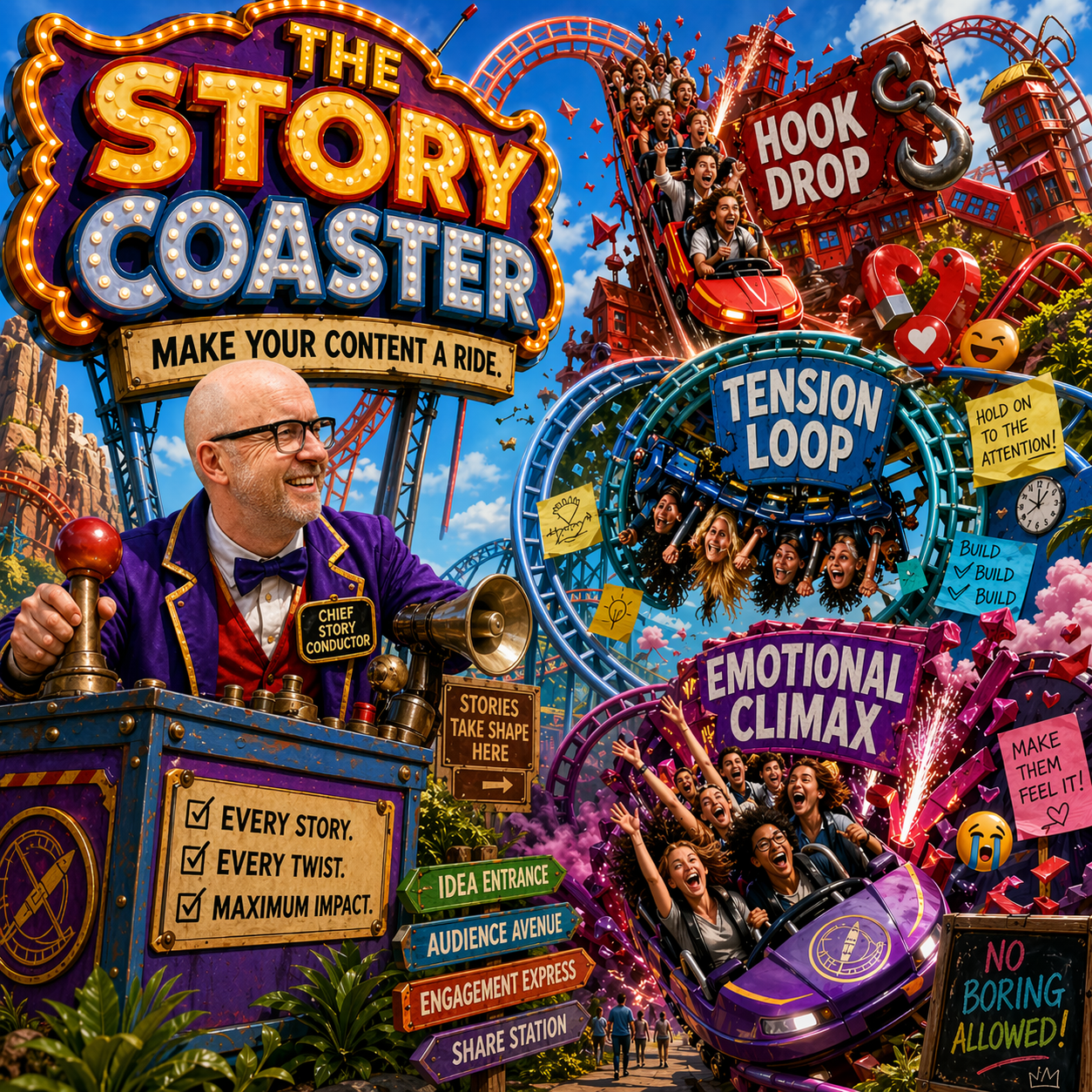
Great stories work like a roller coaster. Most marketing reads like a stretch of State Highway 1 between Bulls and Hunterville. Straight. Predictable. Safe. You can almost feel the cruise control kick in halfway through the second paragraph.
The reader is gone. They didn’t unfollow you, they just stopped feeling anything.
Here’s the villain. It’s not that your content is wrong. It’s that nothing in it changes pace. The hook lands flat, the middle hums along at the same emotional altitude, and the ending fades out like a song that forgot it had a chorus. No drop, no loop, no climax. Just polite information, beautifully formatted, going nowhere.
Great stories work the opposite way. They’re roller coasters.
They yank you up to a peak, drop you into something you didn’t see coming, twist you sideways into tension, and then deliver the climax that makes you walk straight back to the queue to ride it again. Same story shape Joseph Campbell mapped fifty years ago. Same shape behind every film that ever made you cry in row F of an Auckland multiplex.
The reason most AI-generated content is forgettable isn’t the AI. It’s the absence of altitude change. Prompt in, flat road out. No one taught the machine to make you feel something at the 40-second mark, because the person prompting it never asked.
Story-first AI is the fix.
Build the ride first. Find the hook drop. Engineer the tension loop. Earn the emotional climax. Then, and only then, point the AI at it. The output stops sounding like everyone else’s because the underlying structure stops being a flat road.
Your category isn’t boring. Your content has been built without gradient.
If your last three posts could be read in any order without losing meaning, that’s the sign. There’s no ride in them. Send me a message and let’s pull one of your campaigns apart over a coffee or Zoom, find the drops you’ve been flattening, and rebuild it as something worth getting back in line for.